Capacity without progress
Teams are maxed out, yet the roadmap keeps sliding.
Delivery transformation
Built for technology and delivery leaders accountable for getting work shipped. Start with a fixed-scope Delivery Diagnostic — a ranked plan for what’s stuck and what to fix first. If the constraint is worth fixing, we stay with your teams to implement.
Fixed-scope product. Context intake, a prepared call, ranked plan in about a week — about your system, not a generic script.
Why delivery stalls
Most organizations don’t lack talent, tools, or meetings. They lack a reliable path from priority to done. Work accumulates, focus fragments, and leadership slowly stops trusting dates — then stops trusting the system that produced them.
Teams are maxed out, yet the roadmap keeps sliding.
Commitments look solid in slides and soft in reality.
More people often add coordination, not throughput.
Priorities are clear upstairs and contested every sprint.
Where a single piece of work spends its life
In large organizations, the share of elapsed time that work is actively being worked on typically lands between 15 and 25 percent. Which is why better estimates rarely fix a late roadmap — the estimate covers the small part.
The MonkIT promise
Diagnosis without follow-through is theatre. We find what’s slowing delivery, then work alongside leaders and teams until the system actually moves — priorities, flow, and finished outcomes.
Selected environments
Hands-on delivery work across complex organisations — named here by sector, not brand.
What we offer
Most leaders start with the Delivery Diagnostic — a fixed-scope product. From there you choose whether to continue into hands-on Flow Repair, Alignment, or FlowAI.
Typical start: Delivery Diagnostic → optional Flow Repair
A productized first engagement: context intake, a prepared call with a person, and a short ranked plan — where value leaks, what to fix first, and what “better” looks like. Built to forward internally. Not a multi-week assessment, and not hands-on implementation (that’s Flow Repair).
A consultant stays with your leaders and teams to implement the plan — remove constraints, rebuild cadence, and make delivery predictable. This is the work, not a handoff to a junior bench.
When strategy and day-to-day work don’t meet, we put them on one track: clear priorities at team level, decisions that stick, and delivery the business can plan around.
After the fix, keep improving without another coaching cycle. Continuous Flow — powered by FlowAI — is the sustain layer we’re building into engagements, so progress doesn’t expire when the consultant leaves. See FlowAI →
Typical start: Delivery Diagnostic (fixed package). Continue into Flow Repair only when the ranked plan shows a constraint worth fixing.
What changes
Idea to production with fewer waits and restarts
More finished work from the teams you already have
Commitments leaders can defend with eyes open
Bottlenecks visible early — before they become drama
Patterns
Different organizations, remarkably similar root causes. These are the ones we run into most — and what actually moves them.
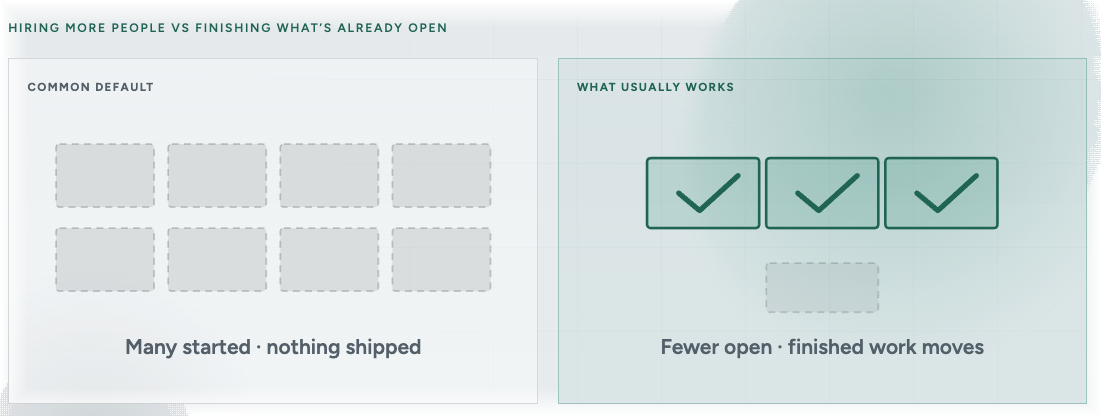
“We need more people.”
What’s usually true There is already more work in progress than the team can finish. Everything sits at eighty percent and nothing ships. Adding people raises coordination cost and work in progress further, so delivery gets slower before it gets faster.
What helps Cap what’s in flight and finish before starting. Throughput usually improves within weeks, without a single new hire.
“Our estimates are always wrong.”
What’s usually true Estimates aren’t the bottleneck — waiting is. Work is actively worked on for a small fraction of its life; the rest is spent queued behind reviews, approvals, environments and other teams. Estimating the active part more precisely cannot fix a timeline dominated by the waiting.
What helps Measure the wait, not the effort, and forecast from how long comparable work actually took.
“Everything is priority one.”
What’s usually true Nobody owns the trade-off, so it gets pushed down to teams who don’t have the authority to refuse anything. Priority ends up being set by whoever escalated most recently.
What helps One ordered list, owned at the level that can actually say no. The ordering is the decision — a bucket labelled “high” is not.
“We keep fixing bottlenecks and nothing improves.”
What’s usually true The constraint moved and nobody went looking for it again. Speeding up a step that wasn’t the constraint simply grows the queue in front of the step that is.
What helps Find the system constraint, fix that one, then look again — it will have moved somewhere new.
“Delivery got slower as we grew.”
What’s usually true Dependencies grew faster than the teams did. Team boundaries follow the org chart rather than the product, so routine changes need three teams to agree before anything can move.
What helps Redraw boundaries around the things that change together, so most work can start and finish inside one team.
“Leadership set the strategy, but teams aren’t following it.”
What’s usually true The strategy exists as a slide, not as a rule anyone can apply. When a team hits a real trade-off on a Tuesday afternoon, the strategy doesn’t resolve it — so they default to the loudest stakeholder.
What helps Translate strategy into criteria teams can apply without escalating: explicit enough to tell them what to say no to.
How we start
One fixed-scope product to start. You share context; we prepare with AI-assisted prep; you still talk to a person. You leave with a ranked plan you can act on — or decline further work with a clear read.
What’s stuck, which tools you use, how work is organized. Enough signal for a useful conversation — nothing that becomes a survey. You also get an instant on-page snapshot.
AI helps prepare hypotheses from your intake. The call is with us — pressure-testing your situation, not a chatbot. Fit, constraints, and what we’d examine first.
A short, forwardable plan: where value leaks, what to fix first, and what “better” looks like. That’s the Diagnostic product — complete whether or not you continue.
Only if the plan shows a constraint worth fixing. We stay with your leaders and teams to implement — and, where it fits, keep improving with FlowAI so progress doesn’t expire.

Led by Sai Kandikattu
The person who diagnoses the problem is the person who helps fix it. About →
Straight answers
Because you get the practitioner, not the pitch team. Large firms often staff senior for the sale and junior for the work. Here the person who diagnoses the problem is the person who helps fix it — and work starts with a fixed-scope Delivery Diagnostic precisely so you can judge the thinking before committing to anything larger.
Most agile transformation and coaching still works inside the current system — frameworks, ceremonies, and skills. We change the system. Shorter cycle time, higher throughput, and commitments you can defend are the goal. If a ritual isn’t earning its place, we remove it.
Both — and Flow Repair is the hands-on core after the productized Diagnostic. The Diagnostic finds what’s stuck and ranks what to fix first; Flow Repair is where a consultant stays with your leaders and teams to implement. We don’t hand you a plan and leave. Alignment and FlowAI are optional next steps when you need them.
Organizations where technology and delivery leaders are accountable for getting work shipped — and where multiple teams, dependencies, or governance make that unpredictable. Typically enterprise IT, product, engineering and data functions, and scale-ups past their first big hiring wave.
It’s a fixed-scope product. You complete a short context intake (and get an instant on-page snapshot). We prepare a 45–60 minute call from that context — about your system, not a generic script. Within about five business days you receive a short ranked plan: where value leaks, what to fix first, and what “better” looks like. Hands-on Flow Repair is optional and separate — only if the plan shows a constraint worth fixing.
One fixed fee: €2,500 per engagement. No seats, no tiers. Flow Repair and other work are priced separately after the ranked plan — only if you choose to continue. See pricing.
No. AI helps prepare for the call from the context you share — likely constraints, questions worth asking, patterns that match similar situations. The conversation is with a person. That split is intentional: better specificity without replacing the diagnosis.
FlowAI is the continuous layer we’re building so improvement doesn’t fall off when an engagement ends — AI-supported guidance grounded in how work actually moves, not another classroom transformation. It’s in early access and offered alongside hands-on work, not as a standalone product drop-in. On a diagnostic call we can tell you whether it’s relevant for your context yet.
We’ll say so on the call, and point you elsewhere where we can. A badly matched engagement costs you far more than a declined one.
Delivery Diagnostic
Share what’s unfinished and how work runs today. You’ll get an instant preliminary snapshot, then a prepared call and a ranked plan you can forward. Flow Repair is a separate decision — only if the plan earns it.